
PhD students participating in August Krogh seminars receive 0,2 ECTS per seminar
AKC seminar: How do animals make sound? (even while holding their breath)
How do animals make sound? (even while holding their breath)
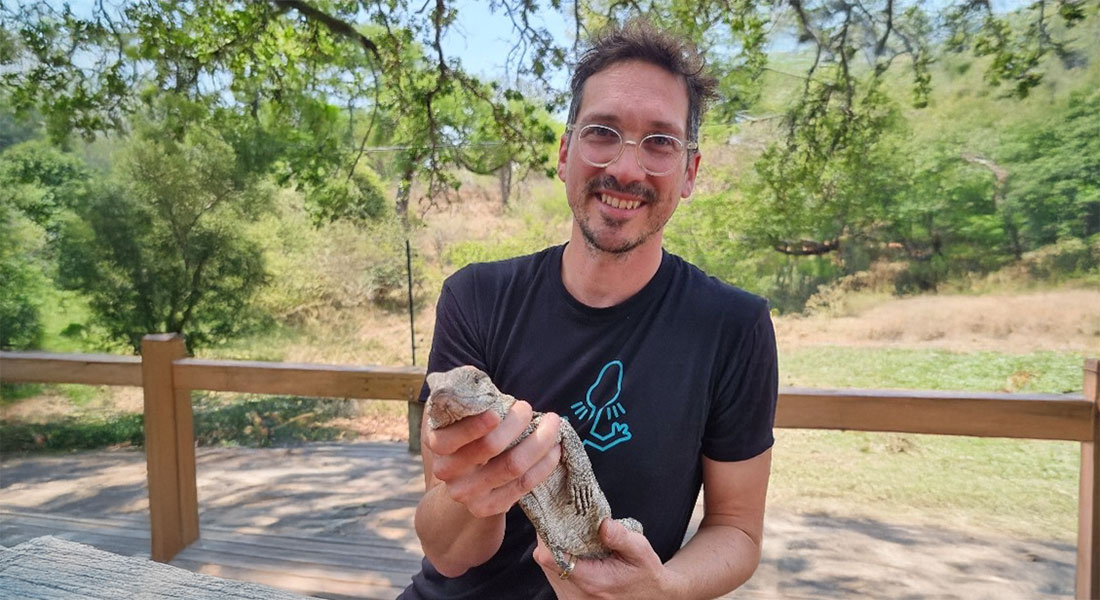
August Krogh Seminar
Coen Elemans
Department of Biology, University of Southern Denmark.
Professor, Sound Communication and Behavior Group.
Abstract
Our voice is essential to human communication, identity and artistic expression and laid the foundation for our unique cultural evolution. Voiced sound production is also the primary form of communication for all mammals, amphibians and birds and comprises highly complicated, precisely coordinated body movements, whose execution is fitness-determining in resource competition and mate choice. Yet, we have only a very rudimentary knowledge of control mechanisms governing the animal and human voice.
How the developing body and brain interact to produce vocal signals critically depends on the biophysical mechanisms that vertebrates employ to produce sounds. Over the last ten years, my lab has studied and elucidated sound production mechanisms across the vocal vertebrates. Next to remarkable adaptations in rodents and aquatic frogs, we have also shown that the myoelastic-aerodynamic theory for human sound production underlies sound generation in many vertebrates including birds, primates, bats, and most recently also toothed and baleen whales. This groundwork was crucial for defining and quantifying the parameters that modulate these vocal signals, and for building embodied models of vocal motor control in the major animal model systems for vocal communication.
Links to relevant literature
https://www.nature.com/articles/s41586-024-07080-1
https://www.science.org/doi/10.1126/science.adc9570
https://www.nature.com/articles/s41467-023-43592-6
https://www.nature.com/articles/ncomms9978
https://www.pnas.org/doi/10.1073/pnas.1922147117
Researcher profile
Professor Coen Elemans is director of the Sound, Communication, and Behavior Group at the University of Southern Denmark, Odense. He received his PhD cum laude at Wageningen University, the Netherlands in 2004, followed by a postdoc at the University of Utah and Buenos Aires. He moved to Denmark in 2008, where he started building the Vocal Neuromechanics lab in Odense.
Coen strives to build a causal model of voice motor control for vocal vertebrates and developed several experimental setups and sensor technologies to studying voice production and muscle physiology, leading to publications in the highest-ranking interdisciplinarity journals (e.g. Nature, Science, PNAS). He has received several international and national science awards, e.g. the Bolk award, MBL Grass Fellow, Fyens Stiftstidendes Science Award and BioMed Central Research Award and outreach prizes.
Time
30 January 2026
14:00-15:00: Seminar and discussion
15:00-16:00: Post seminar servings and socializing
Venue
Auditorium 1, August Krogh Building, Universitetsparken 13, DK-2100 Copenhagen
Registration
Participation is free, but please register here.
For PhD students
PhD students participating in August Krogh seminars receive 0,2 ECTS per seminar
Contact
Anders Gudiksen, anders.gudiksen@bio.ku.dk
